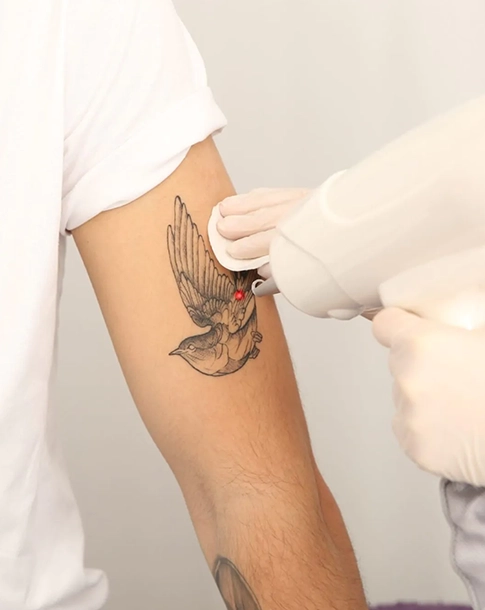
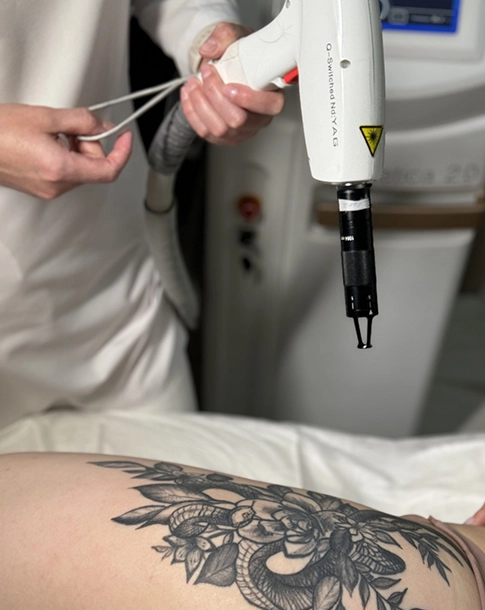
Reduce the visibility of unwanted tattoos over a personalized series of laser treatments.
Laser tattoo removal uses concentrated light energy to break tattoo pigment into smaller particles that the body can gradually clear over time. At MDspa in Las Vegas, treatment begins with a personalized assessment of your tattoo’s size, color, location, age, ink density, and your skin type so your provider can create a treatment plan tailored to your goals and expected response.
Laser tattoo removal is designed to target pigment within the tattoo while minimizing unnecessary damage to surrounding skin. Different wavelengths may be selected for different ink colors, and treatment is usually performed as a series because tattoo particles are cleared gradually between sessions. The amount of fading varies depending on the tattoo and individual response.
Reduce the visibility of unwanted tattoos over a personalized series of laser treatments.
Specific laser wavelengths may be selected to target different tattoo pigments, although some colors respond more easily than others.
Laser settings and session timing are adjusted according to your skin type, tattoo characteristics, and how the area responds over time.
Your consultation gives you the opportunity to discuss whether you want significant fading, preparation for a cover-up, or as much tattoo removal as reasonably possible. Your provider will evaluate ink colors, tattoo depth, location, age, previous treatments, and your skin characteristics before setting realistic expectations and recommending a treatment schedule.
Explore how laser treatment may gradually break down pigment in an unwanted tattoo and what level of fading may be achievable.
Discuss whether partial fading may help create a better foundation for new tattoo artwork.
Learn how different pigments respond to laser wavelengths and why some colors may require more sessions than others.
During treatment, laser pulses are directed at the tattoo pigment. Many people describe the sensation as a quick snapping or stinging feeling, although comfort varies depending on the tattoo size, location, and individual sensitivity. Cooling methods or topical numbing may be used when appropriate to improve comfort during the session.
After treatment, temporary redness, swelling, tenderness, whitening, blistering, or crusting may occur. The treated area needs time to heal between sessions, which is why appointments are spaced apart. Tattoo fading develops gradually as the body processes fragmented pigment.
Laser tattoo removal may be performed on many body areas, depending on skin condition, tattoo characteristics, and treatment suitability. Tattoos in areas with stronger circulation may sometimes respond differently from tattoos farther from the center of the body, so treatment timelines vary from person to person.
Tattoo removal focuses specifically on breaking down tattoo pigment, while other skin treatments may be more appropriate if your concerns involve discoloration, scars, texture, or sun damage. During your consultation, we can discuss whether additional skin treatments may be helpful before or after your tattoo removal series.
The number of sessions varies based on tattoo size, ink color, depth, age, location, and how your skin responds.
Not always. Some tattoos may fade significantly while others may leave residual pigment.
Most patients feel brief heat or snapping sensations during treatment. Comfort measures may be used when appropriate.
The area may be red, swollen, tender, blistered, or crusted temporarily, so proper aftercare is important.
Tell us which tattoo you would like to treat and what outcome you hope to achieve. Start with a personalized consultation at MDspa to discuss your tattoo, treatment timeline, and realistic expectations.
Whether you want to remove an old tattoo, fade ink for a cover-up, or simply understand your options, your consultation gives you time to discuss the tattoo and what you hope to achieve. Our team will assess its size, colors, location, and overall condition before explaining the treatment process and expected timeline.